Month: November 2010

  • Podcast of Watersheds Panel

    The recent (November 17) Shaping SF panel discussion at CounterPULSE was recorded and is posted here. If it’s been topped by more recent podcasts, search or scroll to “Watersheds Lost and Found: San Francisco, Guadalajara, Yuba.”
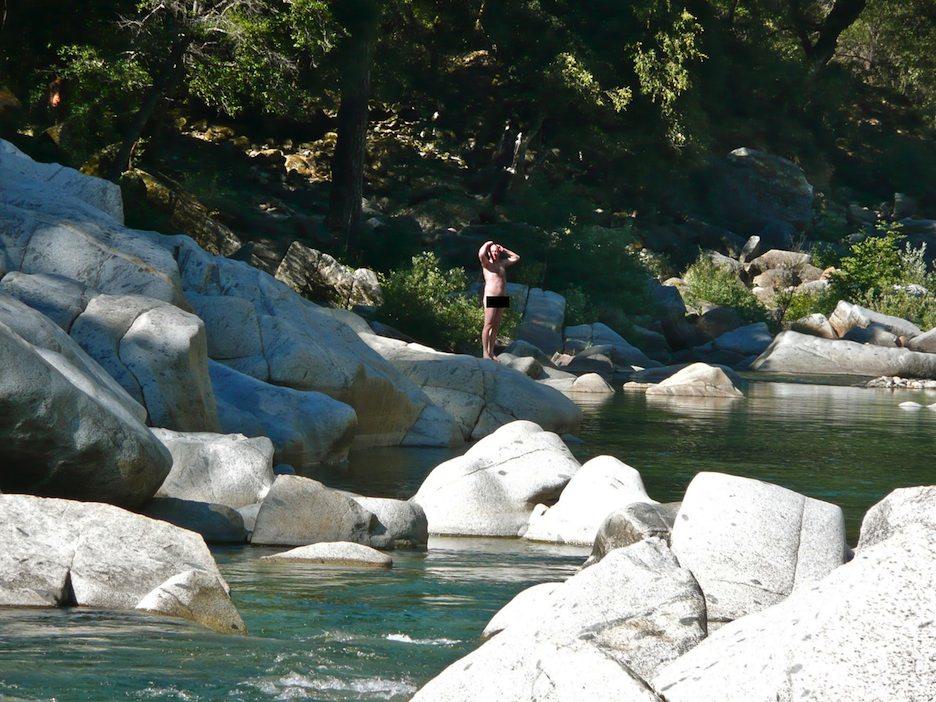
    naked guy?
    Me swimming at the South Yuba River

    My part of it was the San Francisco part, of course, and I was joined by Derek Hitchcock of the South Yuba River Citizens League (SYRCL), and Sarah Kelly and Arthur Richards, co-directors of Adapting to Scarcity.

    The Q&A was excellent and helped me to formulate my long-term concepts about why I do what I do. The short version: I hope to take advantage of an educators’ opportunity available uniquely in San Francisco. I believe that by promoting eco-literacy and humanitarian, egalitarian values among people who live here (or pass through, as most do), it will have a very wide ripple effect.

    The intellectually and financially mobile folks that pass through San Francisco are interested in exploring geography, history and politics, if only to be in on the localistic self-satisfied hipness, though more often out of true curiosity. They are also particularly likely to make cultural impacts here or elsewhere, due to the economic screen of local housing costs and the inherent international draw of the existing cultural creativity, and its reputation.

    I’m not just being snobby. San Francisco is a serious attractant to innovation of many kinds, still strong in progressive values, and cultivates some very important projects, and the people who create them have a lot of moral support here for their work. Add to that the financial facts, and you get people who have enough capital of one sort or another to carry out their creative dreams, not just dream them.

  • Haight Ashbury Map and Guide

    In the mid 1990s, I helped create two pieces of printed matter that I had no idea would hit it off one day. With each other.

    Strange, but true: Stannous Flouride’s Star Map of the Haight and 409 House’s Directory of Local Services found one another, fourteen years later, and got hitched. The resulting Haight Ashbury Map & Guide is the latest incarnation of a long history of local resource guides and maps.

    Stan approached me about producing his first handmade “Star Map” of the Haight, and I helped him get the thing printed. It’s seen many versions since, and it’s now been incorporated into this new publication, thanks to Stan and the folks at Rufus Graphics, Booksmith, and Flower Power Tours.

    Definitely post-psychedelic period

    Here’s what it’s ancestor looked like in 1996. The Haight Ashbury Service Association, based at 409 Clayton, hired me to research and publish this enticing yellow “first” edition, which was itself a continuation of a long trend in free information resources about the neighborhood, begun with the Haight Ashbury Switchboard in 1967.

    In 2010, the new, colorful 21-page, combined Map & Guide has a fold-out map and pages about neighborhood history, things to do, and transit, but the services section is shrunken. Perhaps that’s because times have changed for the Haight and services are minuscule now.

    As another a sign of the changes, the Guide actually costs money. What a crazy idea!

    Of course, we at Thinkwalks feel some attachment to the result of Jack & Gay Reineck’s hard work, so we’re, um, selling it too! Just $7 and you get a surprisingly in-depth overview of local history and fun.

  • Laguna Honda watershed

    Check out what interesting stuff I’ve sleuthed up for the “trek” I’m leading with Nature in the City on November 14th.

    The tour will start in Golden Gate Park, because since the late 1800s, the Laguna Honda watershed has been a main source of water for irrigation of the Park.

    The creation of the irrigation system happened at the time when the Park was being entirely re-configured. Development of Golden Gate Park had been firmly within the “rustic” aesthetic of William Hammond Hall. Then railroad magnate Collis P. Huntington gave funds to build a waterfall and land speculator Thomas U. Sweeney donated for a fortress-like observation deck on top of the hill in the center of the reservoir.

    The grand entry of Sweeney observatory was reflected in a 50,000 gallon pool which provided the headwaters of the falls.

    This was the turning point for the Park, after which everything was named for funders (e.g., Huntington Falls) and no longer for function (e.g., Deer Glen).

    That’s right, I’m referring to Stow Lake as a reservoir. It was dug into the hillsides surrounding Strawberry Hill so that water pumped out of the dunes near 13th Ave. and Lincoln Way could be stored, then flow to all the new planted areas of the Park by gravity.

    We’ll head up to see the abandoned reservoir at Laguna Honda itself, of course. Come join us next Sunday, and learn more! These watershed tours tend to attract a lot of knowledgeable people who have much to share!
    RSVP to linda at natureinthecity dot org.