Since the Big Summit last week, ARkStorm has been getting a lot of press. Most of the coverage has been simply warning the public that a Big One could happen in the form of a superstorm, rather than a quake. The public interest is generally portrayed as being strictly about natural hazard emergency response.
Official preparation is certainly important. Information about the science and history of storms also needs to be emphasized. In fact, it’s in some ways even more important for the public to understand the implications in context, than it is for officials to take protective action.
With that in mind, here is some scientific and historical context.
As the shouting from a recent spate of dire announcements inevitably goes quiet, the ARkStorm project scientists have some very interesting work ahead. The team of hundreds is tasked with creating a new system for rating storms. Currently, storms are rated only based on wind speed (for tropical storms) or on frequency. The new system would use a variety of storm attributes.
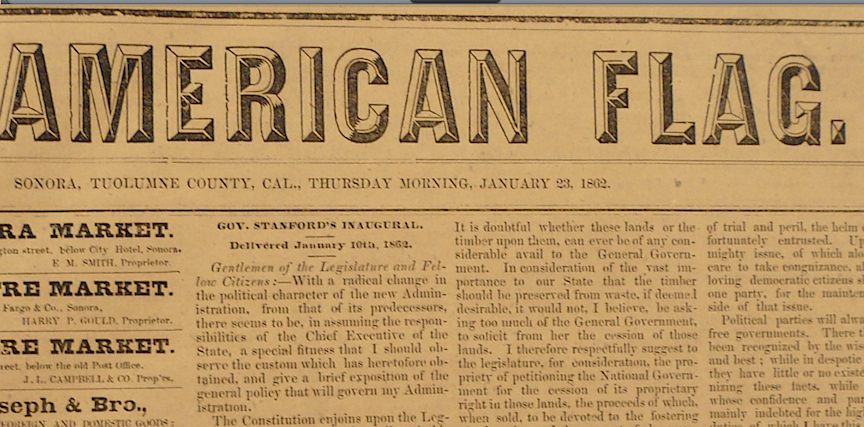
The ARkStorm “Big One” is modeled on a giant storm—an approximation of the very storm (1862) I’ve been researching myself these past eleven months. Such a large storm has been a rarity. Though it could happen twice in a row or not for a long time, a storm this size has come to California, we’re told by some press releases, an average of about twice every thousand years. That’s why it’s sometimes called a 500-year storm. Others call it the 100-year storm, for reasons I can’t understand.
But all these numbers are seriously misleading.
Location location location
First, the location is an issue. Even if we assume the averages are good predictors, we have to ask: predictors of what? A storm this big somewhere or other? A storm this big in the same place as before? And how wide an area? I’ve seen scientific texts saying the 1862 storm was not a 500-year storm unless viewed in a single location, but is instead a 30,000-year (or more) storm. This larger number is based on frequency of storms of that size happening simultaneously throughout California and Oregon.
Extreme weather events
Calling it a 500-year storm also won’t hold up to the fact that extreme weather is increasing in frequency. If the ARkStorm project aims to create a new storm severity rating system that can be used to compare storm strength on a more absolute scale (just as the Richter scale is used for earthquakes), then they have a lot of factors to consider. These range from depth of precipitation to concentration of local effects, duration, and perhaps even damage levels.
The resulting system would be better than the Richter scale in at least one important way. The severity of a storm can be estimated before the storm has dumped its full load and done all its damage.
They’re setting the 1862 storm at 1000 on this new scale, which is exactly what the ‘k’ in ‘ARkStorm’ stands for. The ‘AR’ is ‘Atmospheric River’, the massive airflow mechanism that funnels so much tropical moisture to the coast for long stretches in some years (including a few weeks ago when many inches of rain fell in Southern California in a single downpour).
Damage is a tricky metric
Of course, sometimes a small storm can do a lot of damage. For example, in 1955, a serious storm caused floods in many California locations, but it created a special havoc near Visalia, California, in the Kawea River Valley. In a steep part of the canyon, where big trees grow—just beside Sequoia National Park—some trees became upended and wedged. The resulting dam of debris built up a large lake behind it, breaking loose all at once.
The torrent that resulted was so large that, to this day, cores and wells drilled twenty or thirty miles out into the Central Valley often hit pockets of buried wood from trees flushed out of the Sierra Nevada mountains in a gush that rivaled Flushing, New York. (Just a little place name humor there. Forgive me.)
The quake leads to fires; the storm leads to floods
A storm’s damage level has, and clearly needs, a completely different method to measure it. I’m not crazy about the way damage is currently measured: Dollar amounts referring to repairs are not the main details that count, but that’s the standard system.
Science literacy is a life-or-death issue
When the hard work of protecting property is at hand, educating the disparaged public about the science may not seem important. But getting folks to pay attention usually is probably a fruitless effort, unless a great number of people can understand the bigger picture.
Dire warnings, without the empowering context of science and history, leave people making helpless and fatalistic quips, as offered in such comments as these, which are, soberingly, in an insurance discussion.
For our culture to shift, so we can avoid repeated Katrina-like panics and disasters, everyone affected should be treated as serious partners in solving the science. After all, a storm that big did happen in 1862 and will again, to a population much larger and more densely occupying the lowlands.
Why are we so blind to it?
I’ve been stunned to find how few people—even among flood control professionals—know about the 1862 storm’s severity! Flood control folks are the natural choice for who should be letting us all know about this fact of life.
According to M. Fred Strauss, a former water engineer for the State of California who says he did the first assessment of the flood levels from the 1862 storm, the probable reason for the blinders is the impossibility of measuring up to such high standards. Flood control efforts will never be able to prevent serious devastation from an “ARkStorm.” Therefore, he says, the natural purveyors of such information have an incentive not to spread the word about it. It would only get the hopes of the public up and create impossible-to-meet expectations.
All the more reason to focus on educating the public fully. Simply promoting safety measures is both foolhardy and patronizing.